 Inside China Tech

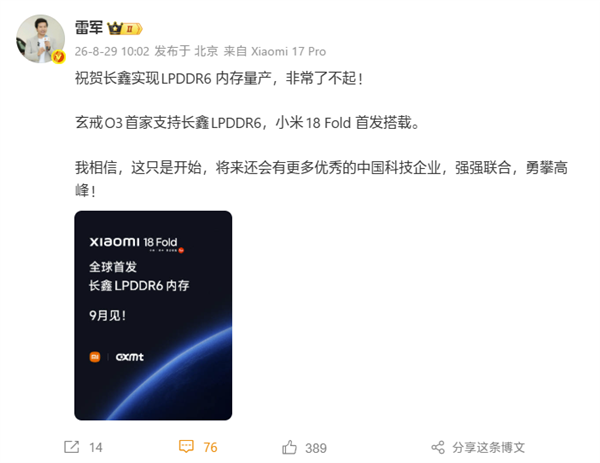
Xiaomi founder Lei Jun today congratulated domestic DRAM maker CXMT on achieving mass production of its LPDDR6 memory, calling it a “truly remarkable” milestone for China’s semiconductor industry.
He also confirmed that the XRING O3 is the first mobile SoC to support CXMT’s LPDDR6, and that the Xiaomi 18 Fold will be the world’s first device to launch with this chip-and-memory combination.
XRING O3: First Chinese Mobile SoC Past 5 Million AnTuTu
The XRING O3 is built on a 3nm process with a 10-core all-big-core CPU architecture paired with a 16-core G2-Ultra GPU. It scored over 5.22 million points in AnTuTu lab testing, making it the first Chinese mobile SoC to break the 5-million mark.
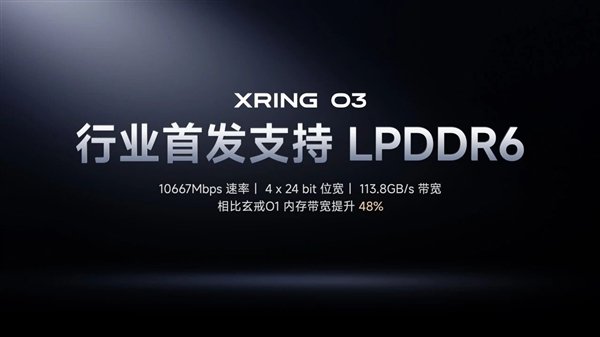
The chip natively supports JEDEC’s latest LPDDR6 standard at a base rate of 10,667 Mbps, delivering 113.8 GB/s of memory bandwidth through a 4×24-bit dual-channel architecture. That represents a 48% bandwidth increase over the original XRING O1, designed to handle data-hungry workloads like on-device AI inference, heavy gaming frame rendering and parallel document processing.
CXMT LPDDR6: Matching Global Leaders on Next-Gen Memory
CXMT’s LPDDR6 peaks at 12,800 Mbps per die, with single-die capacities up to 16 GB using POP (Package-on-Package) stacking. The company says it has completed customer sampling validation and is now ramping up volume production — marking the first time a Chinese DRAM maker has reached parity with international incumbents on a new-generation mobile memory standard.
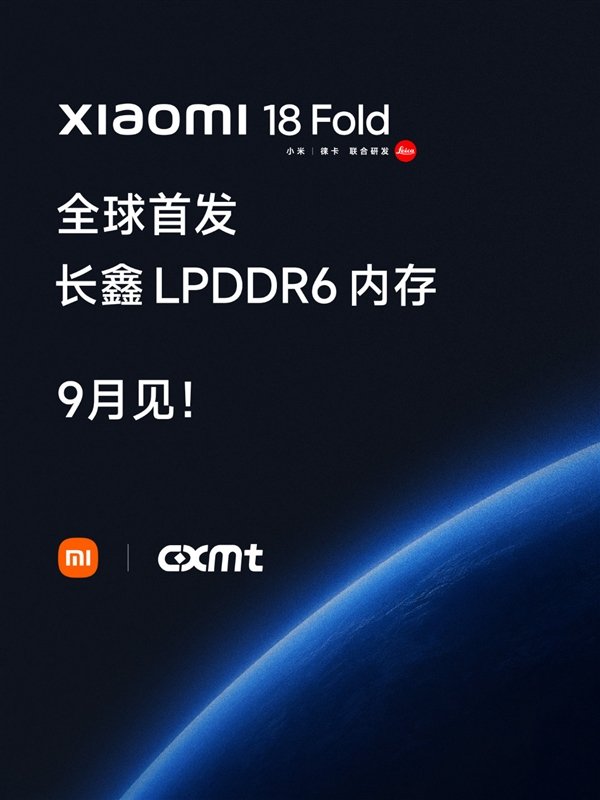
The Xiaomi 18 Fold, a wide-aspect foldable flagship, will be the first device to bring this combination to market, leveraging the extra bandwidth to improve multi-window multitasking and on-device large-model performance on its expansive high-resolution display.
Comments
Join Inside China Tech to join the conversation.