 Inside China Tech
Smartphone Memory Prices Surge 80% in Q2: DRAM Overtakes SoC as Flagship’s Costliest Component
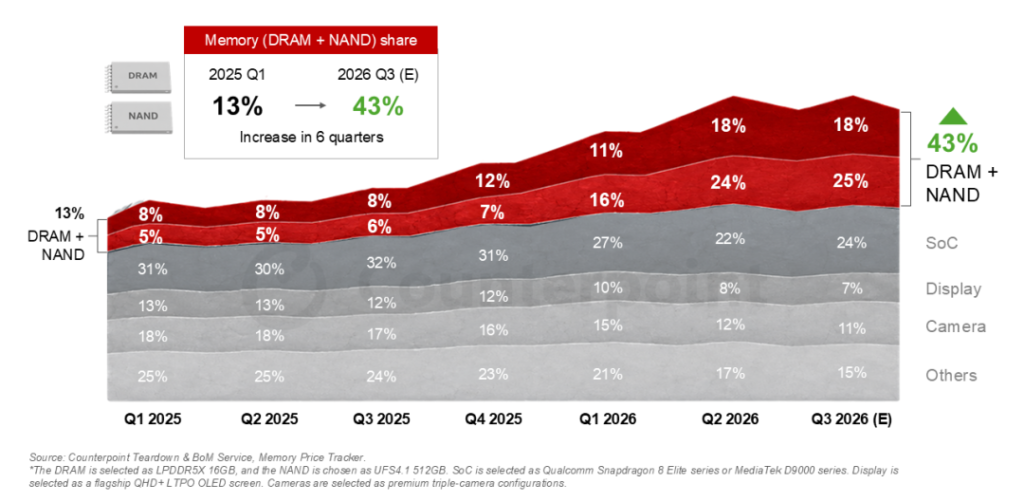
July 29, 2026 — According to a new industry analysis from Counterpoint Research, smartphone memory prices saw a staggering quarter-on-quarter increase of over 80% in the second quarter of 2026. This sharp price hike is fundamentally reshaping the Bill of Materials (BOM) cost structure for smartphones, leading to significant production cost increases across all market segments and intensifying profitability pressures throughout the industry.
BOM Cost Impact Across Market Segments
Compared to similarly specced models from 2025, the BOM cost structure for 2026 smartphones has shifted dramatically:
- Low-End (Wholesale Price < $200): In Q2 2026, the BOM cost for these devices grew by 70% year-on-year, with nearly all of the increase driven by storage costs. To mitigate the risk of losses, smartphone OEMs have significantly scaled back their expectations and adjusted their product portfolios for entry-level devices.
- Mid-Range (Wholesale Price $400 – $600): BOM costs in this segment grew by 52% year-on-year. Memory now accounts for 40% of the total BOM. Consequently, the trend of over-specifying processors and imaging systems in this price range is decreasing.
- Flagship (Wholesale Price > $800): The BOM cost for flagship models also grew by nearly 50% year-on-year. In a significant shift, DRAM has surpassed the SoC to become the single most expensive component in flagship smartphones. This cost pressure has led to higher launch prices for several new flagship models compared to their predecessors.

High-Capacity Models and Future Outlook
The cost increase is even more pronounced for models equipped with large-capacity NAND storage. It is estimated that the BOM cost for a 1TB iPhone 18 Pro Max has increased by nearly $300 compared to last year’s 1TB iPhone 17 Pro Max.
To balance cost pressures with market demand, smartphone OEMs are adopting differentiated pricing strategies for various storage configurations. Some manufacturers are also expected to introduce more cost-effective NAND solutions to control the BOM cost of high-capacity models and mitigate the final retail price increase.
Analyst Outlook:
Counterpoint analysts note that while OEMs have tried to alleviate cost pressure on mid-to-low-end models by optimizing their product mix, they still face risks of shrinking profit margins or even losses on certain models. Furthermore, the continuous rise in BOM costs for flagship devices is slowing the adoption of innovative technologies in areas like displays and imaging.
The report also forecasts that the future introduction of 2nm flagship SoCs will further inflate the BOM cost of high-end phones. Even if OEMs raise retail prices, the overall gross margins for this generation of flagships are expected to be slightly lower than those of their 2025 counterparts.
Comments
Join Inside China Tech to join the conversation.