 Inside China Tech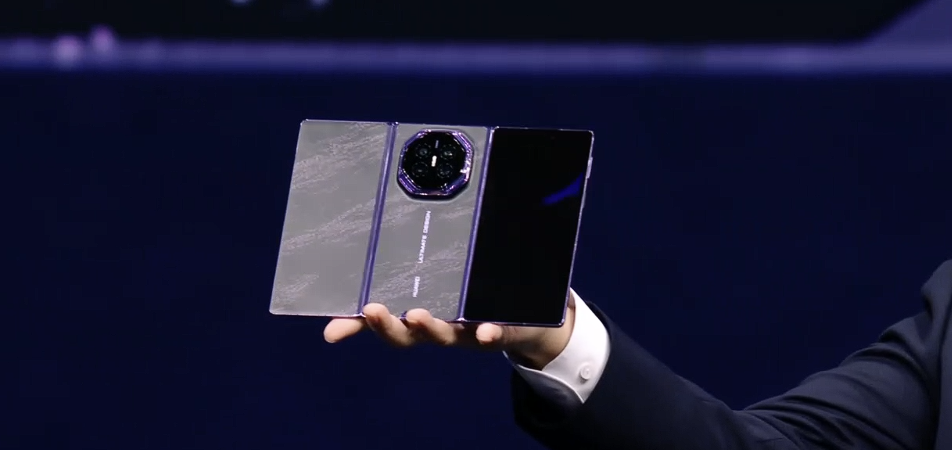
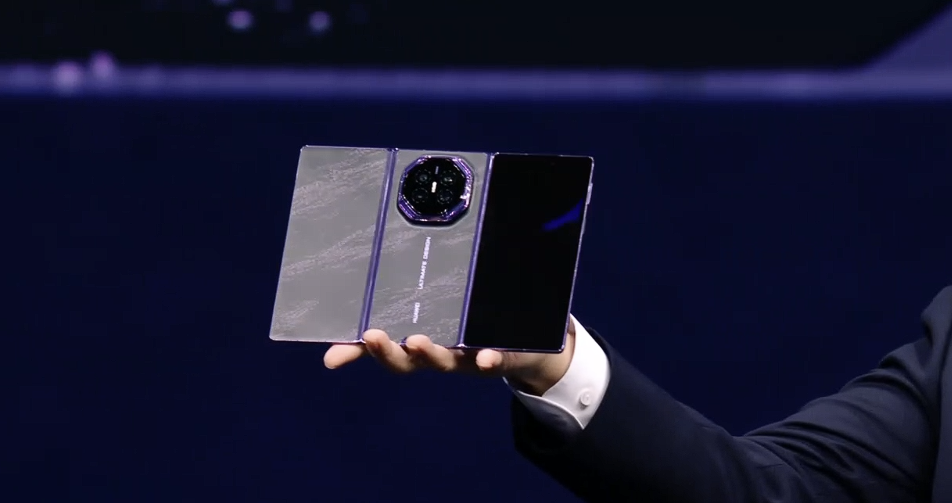
Huawei unveiled the Mate XT 2 Ultimate Design at its HarmonyOS 7 and full-scenario product launch on Monday, its second-generation tri-fold flagship. The device debuts the Kirin 9050 Pro — the industry’s first mass-produced ‘logic-folding’ smartphone chip and Huawei’s first in-depth Kirin reveal since the Mate 40 series six years ago.
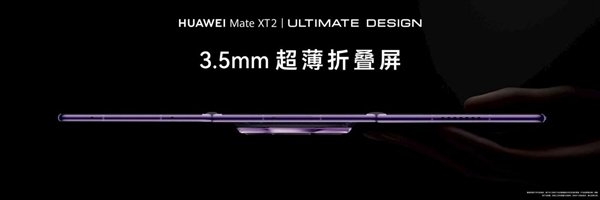
A 3.5mm Folded Profile
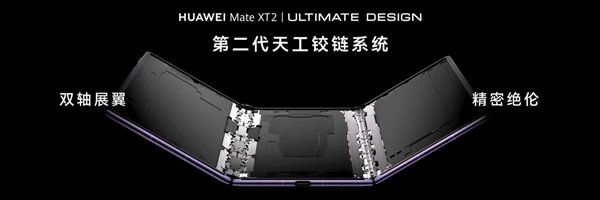
The Mate XT 2 adopts an all-new ‘dual inward-folding wing’ tri-fold structure. Unlike the previous Z-style fold, its two side panels fold inward while the main display tucks fully into the chassis, keeping every flexible fold zone on the inner side when closed. Folded, the body is just 3.5mm thin — the slimmest profile in the Mate XT line. It ships in Mystic Black, Porcelain White, and Brocade Purple.
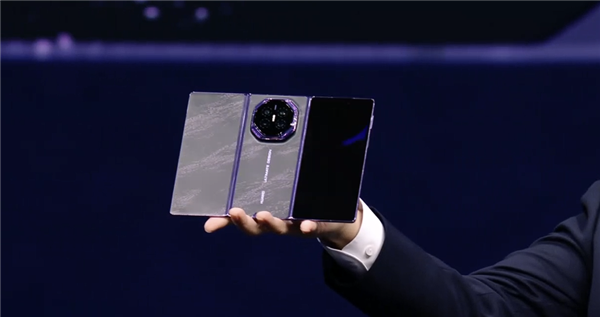
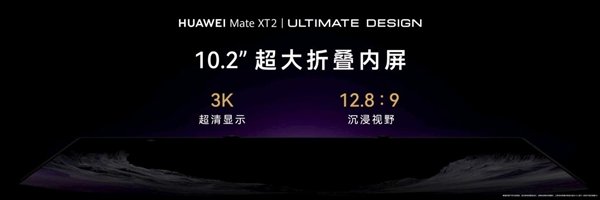
Display: 10.2-inch Inner Panel, Dual-layer Cover Screen
A standalone rigid dual-layer OLED cover screen handles calls, messages, and QR payments without unfolding the device. Fully opened, the inner panel is a 10.2-inch display at 2232×3184, using UFG ultra-flexible glass with 1–120Hz LTPO adaptive refresh and 1440Hz high-frequency PWM dimming. Huawei offers two variants — a Lingdun hardware privacy version and a standard shareable version — switchable with a double tap.
Imaging: Flagship Triple Camera Plus Red Maple
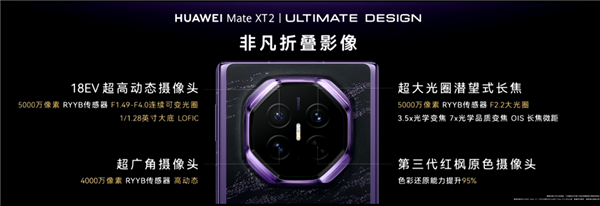
Imaging sits at the top of the tri-fold class: a flagship triple camera plus the third-generation Red Maple true-color camera. The main sensor is an 18EV ultra-high dynamic range unit with a 50MP RYYB sensor, F1.49–F4.0 continuously variable aperture, a 1/1.28-inch sensor, and LOFIC technology.
The ultra-wide uses a 40MP RYYB sensor, while the periscope telephoto is a 50MP RYYB unit at F2.2 with 3.5x optical zoom, 7x optical-quality zoom, OIS, and macro. The third-generation Red Maple camera lifts infrared transmission 100% and per-pixel light intake 96%, improving color accuracy 95% over the Mate XTs. The rear module also integrates a photoelectric sensor for the industry’s first ECG heart-rate analysis — press it to capture heart rate, ECG, and blood-oxygen data synced to the fitness app.
Kirin 9050 Pro: The First Logic-Folding Chip
The Kirin 9050 Pro is a mass-produced logic-folding chip built on the τ-law (Tao’s law) approach. Its Lingxi CPU uses an ultra-threaded 9-core layout: 1 Prime, 2 Performance, 4 Efficiency, and 2 Little cores. Layered logic stacking with new vertical interconnects lifts single-core peak performance 24% and multi-core concurrency 52%.
It integrates the Maleoon GPU and Da Vinci NPU. Maleoon supports hardware-level ray tracing at 50 million rays in real time, with 142% better rendering and 40% faster 4K export. The Balong baseband improves satellite paging success by 42% and adds first-ever low-earth-orbit broadband satellite support. Overall system performance is up 42% versus the Mate XTs.
Connectivity, HarmonyOS 7, and Pricing
Connectivity covers 5G, eSIM, UWB ultrawideband, Wi-Fi 7, NearLink, Tiantong satellite calling, and Beidou satellite messaging. The phone ships with HarmonyOS 7, tuned for tri-fold large-screen interaction — multi-window free layout, cross-app handoff, and multi-screen collaboration — and drops the Android compatibility layer entirely, running on Huawei’s self-developed framework.
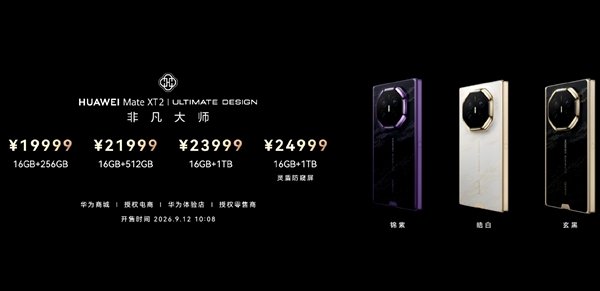
Huawei Mate XT 2 Ultimate Design comes in four configurations, on sale September 12 at 10:08 (Beijing time):
16GB+256GB — ¥19,999
16GB+512GB — ¥21,999
16GB+1TB — ¥23,999
16GB+1TB Lingdun privacy version — ¥24,999
Comments
Join Inside China Tech to join the conversation.